

Key Takeaways
Choosing replacement parts by component makes Audi maintenance more precise, especially when several versions of the same model share similar names.
- Confirm the VIN, model year, trim, engine code, and drivetrain before ordering.
- Compare genuine, OEM, remanufactured, and aftermarket options by fit, quality, and warranty.
- Treat timing, cooling, braking, steering, and safety components as high-priority systems.
- Check part numbers, side orientation, connector style, and supersession details carefully.
- Allow for coding, calibration, alignment, or specialist installation when required.
Understanding Audi parts by component
Researching specific Audi Parts by Component is more reliable than searching by model name alone. A single model may use different brakes, sensors, suspension pieces, or electrical modules depending on its build date and equipment. Starting with the component also helps separate a failed part from nearby parts that may only appear related.
Why component-based parts research matters
A component-based search narrows the question from “Which parts fit my Audi?” to “Which version of this exact system fits my vehicle?” That distinction matters because an engine cooling issue, for example, could involve a thermostat, water pump, radiator, hose, fan, or sensor. Naming the system first gives a technician or supplier a clearer starting point.
It also makes diagnosis more economical. Replacing a complete assembly may be unnecessary when a serviceable individual component is available, while replacing only a small part can be false economy if the surrounding assembly is worn.
Audi Genuine, OEM, and aftermarket parts compared
Genuine parts are supplied through the vehicle manufacturer’s parts channel, while OEM parts are made to the original supplier’s specifications and aftermarket parts come from independent manufacturers. Quality and fit can vary within each category, so the label should be considered alongside the part number, warranty, construction, and supplier reputation.
For a useful comparison of terminology and fit considerations, see this guide to Audi OEM parts. A used genuine component or a carefully selected aftermarket replacement may make sense for an older vehicle, provided its condition and compatibility are established.
How model year, trim, and engine affect compatibility
Model names are only the first layer of identification. A change in engine code, transmission, body style, trim package, emissions equipment, or production date can alter mounting points, connectors, dimensions, software, and service procedures.
The safest approach is to compare the vehicle build information with the supplier’s fitment data. Photos can help, but they should support—not replace—the VIN and part-number check.
When to replace versus repair a component
Repair is sensible when the component is designed to be serviced and the underlying housing, mounting points, and electrical connections remain sound. Replacement is usually more appropriate when a part is cracked, internally damaged, unsafe, contaminated, or likely to fail again after a temporary fix.
A repair decision should include labor, access, testing, and the age of related parts. The cheapest part is not always the cheapest repair once repeated diagnosis and installation time are included.
Engine and cooling system components
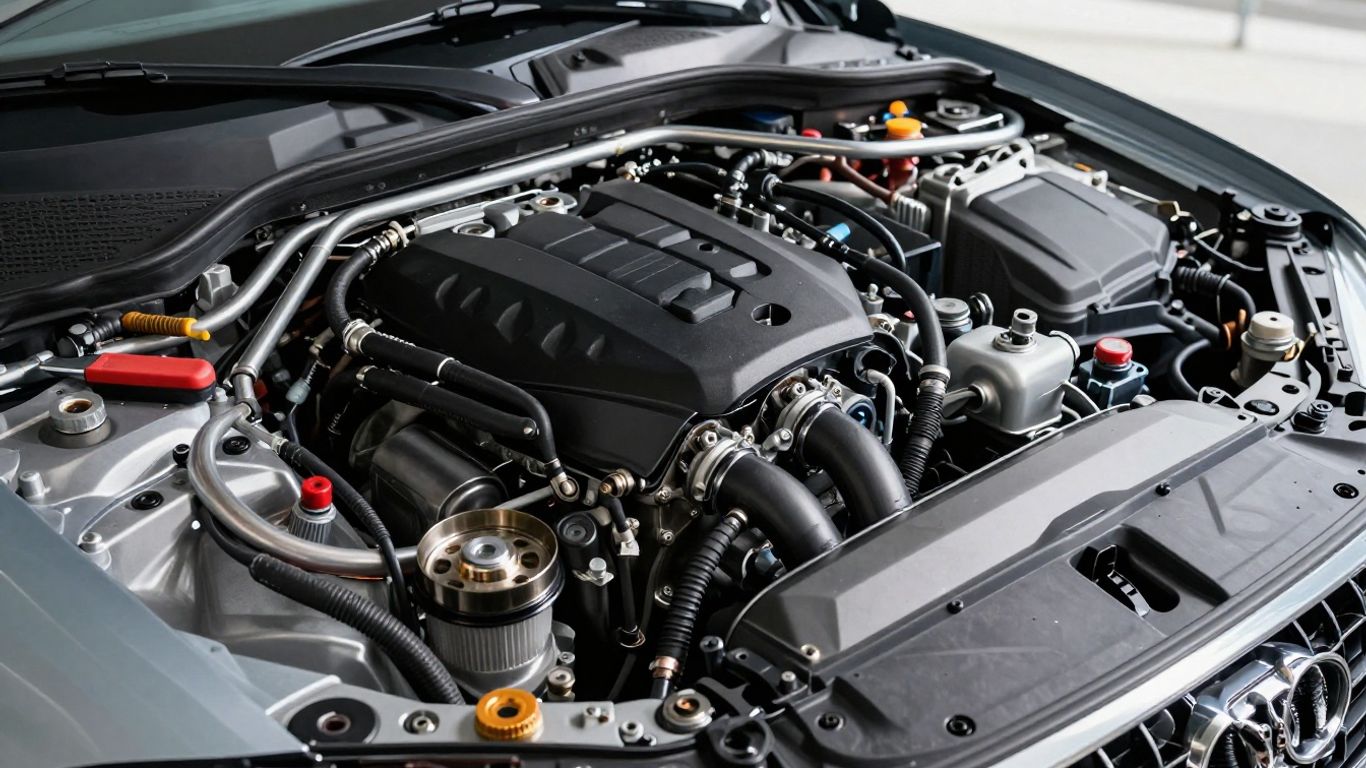
Engine parts work as a connected system, so one symptom may have several possible causes. Oil pressure, airflow, ignition, fuel delivery, temperature control, and emissions equipment all influence how the engine starts and runs. Begin with testing rather than ordering from a symptom alone.
Common Audi engine parts and their functions
Major engine components include pistons, connecting rods, crankshafts, cylinder heads, valves, gaskets, mounts, and covers. External systems add ignition coils, spark plugs, injectors, throttle bodies, sensors, and vacuum or boost plumbing.
Their functions overlap. A rough idle may involve ignition, air metering, fuel delivery, a vacuum leak, or compression, so fault codes should be interpreted with physical inspection and live data where appropriate.
Timing belts, timing chains, and tensioners
Timing belts and chains keep crankshaft and camshaft movement synchronized. Their tensioners, guides, pulleys, and related seals are equally important because wear in one part can affect the whole timing system.
Replacement intervals and procedures depend on the engine. A belt or chain job may require special locking tools, precise marks, and post-installation checks, making reliable engine identification essential before work begins.
Oil, air, and fuel system components
Oil filters, pumps, coolers, seals, air filters, intake hoses, intercoolers, fuel pumps, rails, injectors, and pressure regulators each have distinct roles. Contamination, leaks, restricted flow, and incorrect pressure can produce similar drivability complaints.
Inspect the old part and the surrounding system. A failed seal may point to excess pressure, while a damaged intake hose may allow unmetered air and create a misleading sensor fault.
Radiators, water pumps, and thermostats
The cooling system manages engine temperature through the radiator, water pump, thermostat, expansion tank, hoses, fans, and temperature sensors. Plastic tanks, seals, impellers, and electrical connectors can all deteriorate with age.
A cooling repair should include leak testing and a check for trapped air. Simply replacing the visible leaking component may leave a weak hose, faulty fan, or thermostat problem unresolved.
Warning signs of engine component failure
Warning signs include persistent overheating, coolant loss, oil contamination, hard starting, unusual smoke, poor acceleration, new tapping or rattling, and a flashing engine warning light. None of these signs identifies a part by itself.
Record when the symptom occurs, whether the engine is hot or cold, and whether it changes under load. That information can prevent an unnecessary parts swap and help distinguish mechanical wear from an electrical or control issue.
Transmission and drivetrain parts
The drivetrain transfers engine torque through the transmission, differential, axles, hubs, and wheels. Front-wheel-drive and quattro configurations can use different housings, shafts, mounts, and service procedures. Matching the drivetrain layout is therefore just as important as matching the engine.
Manual and automatic transmission components
Manual transmissions contain gears, synchronizers, bearings, shafts, seals, and a clutch interface. Automatic transmissions add valve bodies, torque converters, pumps, clutch packs, mechatronic components, and control systems.
Fluid type and service procedure are not interchangeable between transmission families. Use the transmission code and approved specification rather than relying on fluid color or a generic description.
Quattro all-wheel-drive system parts
An all-wheel-drive system may include differentials, couplings, transfer components, propeller shafts, axles, control units, and specialized lubricants. Tire circumference and service condition can also affect how the system behaves.
Before ordering a drivetrain component, verify the exact system version and axle position. A visually similar coupling or shaft may have different spline counts, lengths, mounting points, or electronic requirements.
Clutches, flywheels, and torque converters
Manual clutch repairs commonly involve the clutch disc, pressure plate, release bearing, and flywheel. Depending on the application, the flywheel may need inspection for heat damage, excessive movement, or surface irregularities.
Automatic vehicles use a torque converter rather than a conventional manual clutch, though internal clutch packs still manage gear changes. Symptoms such as slipping, shuddering, or delayed engagement need fluid, pressure, and electronic diagnosis before replacement.
Axles, driveshafts, and CV joints
Axles and CV joints transmit power while allowing suspension movement and steering angle. Torn boots can release grease and admit contamination long before a joint becomes noisy.
Check inner and outer joints separately, along with shafts, seals, wheel hubs, and mounting hardware. Replacing a boot may be reasonable when the joint is clean and undamaged; clicking or excessive play generally points toward replacement.
Diagnosing drivetrain noise and vibration
Noise during acceleration, deceleration, turning, or coasting gives useful clues, but road-testing should be done safely. Vibration can arise from a wheel, tire, engine mount, axle, propeller shaft, differential, or transmission rather than one obvious part.
A written symptom pattern is helpful: speed, throttle position, road surface, steering angle, and temperature. Avoid ordering from a sound description alone when several rotating components can create the same sensation.
Suspension, steering, and brake components
Chassis parts influence ride quality, handling, tire wear, and stopping distance. They also interact closely, so replacing one worn arm or damper may reveal play in another component. Inspection should cover the complete corner of the vehicle rather than only the part named by an initial guess.
Shocks, struts, springs, and control arms
Struts and shocks control suspension movement, while springs support the vehicle and control arms guide wheel motion. Bent arms, leaking dampers, sagging springs, and worn mounts can change alignment and steering feel.
After suspension work, inspect ride height and tire wear. Alignment may be required when control arms, tie rods, subframe parts, or other geometry-related components are replaced.
Bushings, ball joints, and wheel bearings
Bushings isolate movement and vibration, ball joints allow controlled articulation, and wheel bearings support rotation. Cracks, looseness, uneven wear, humming, or movement at the wheel can point to these parts, but symptoms often overlap.
A bearing should be checked for play and noise under safe conditions. A bushing may look intact while separating under load, so a visual inspection alone is not always conclusive.
Steering racks, tie rods, and power steering parts
Tie rods connect steering movement to the wheels, while the rack or steering gear converts input into lateral motion. Hydraulic and electric assistance systems use different pumps, motors, sensors, fluids, and control strategies.
Steering faults deserve prompt attention. Excessive play, fluid leakage, uneven response, warning lights, or a steering wheel that no longer centers should be diagnosed before further driving.
Brake pads, rotors, calipers, and sensors
Brake pads create friction against rotors, calipers apply the pads, and wear sensors or electronic systems report service conditions. Rotors can suffer from thickness loss, corrosion, heat damage, or uneven surfaces.
When choosing a brake set, confirm axle position, rotor dimensions, caliper type, sensor arrangement, and electronic parking-brake requirements. Replacing pads without addressing a sticking caliper or damaged hose can shorten the life of the new parts.
Choosing components for comfort or performance
A comfort-focused setup generally prioritizes controlled damping, low noise, compliant bushings, and predictable ride quality. A performance-oriented setup may use firmer springs, dampers, bushings, or braking materials, but those choices can increase harshness and maintenance demands.
Use the vehicle’s normal purpose as the deciding factor. Parts should work together as a matched system rather than being selected for a single impressive specification.
Electrical and electronic Audi parts
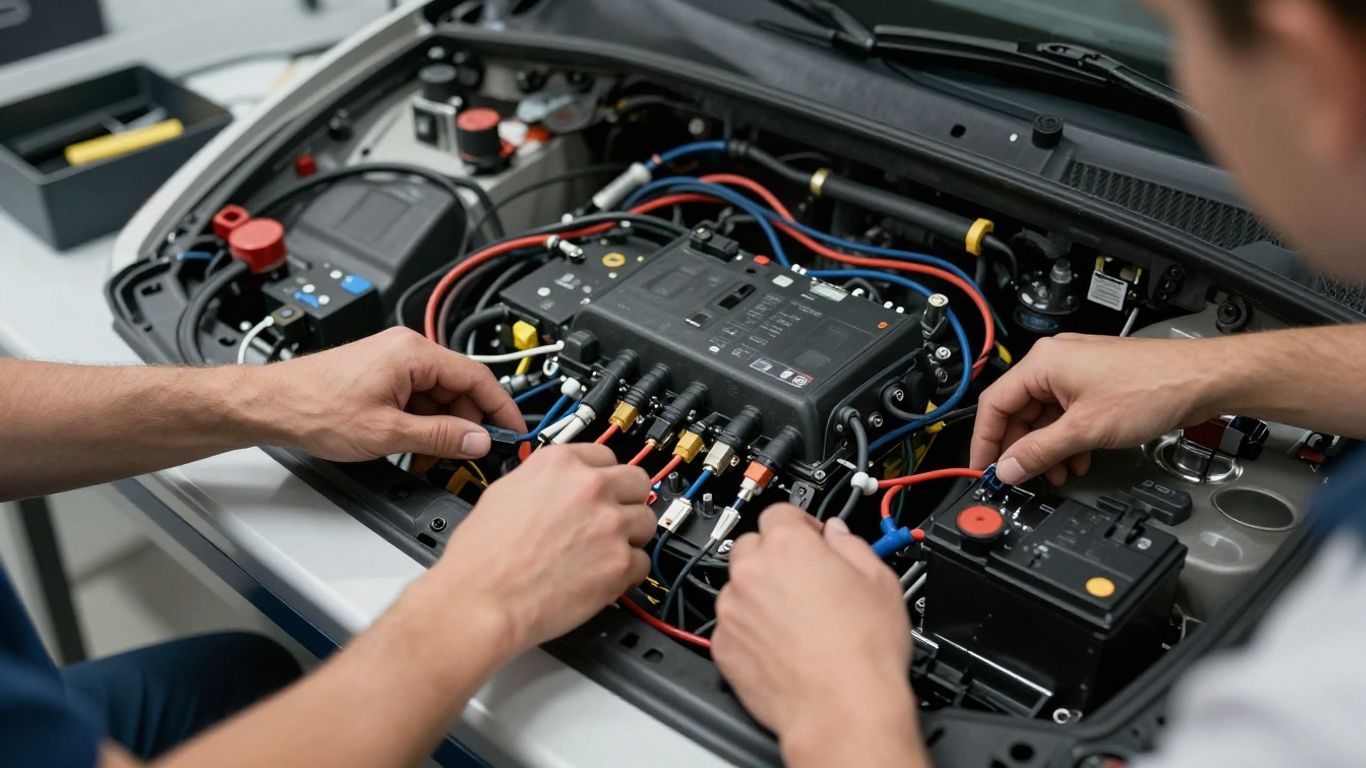
Electrical faults can be difficult because a failed component, weak connection, discharged battery, or software issue may produce similar symptoms. A proper diagnosis begins with voltage, grounds, fuses, connectors, and communication checks. Replacing a module before confirming the circuit can create extra expense.
Batteries, alternators, and starter motors
The battery stores electrical energy, the starter motor turns the engine, and the alternator replenishes the battery while the engine runs. Battery capacity, terminal condition, charging voltage, and starter current all matter.
A new battery does not correct an alternator fault, and an alternator may not solve a parasitic drain. Test the charging and starting system as a group before choosing the replacement component.
Sensors, control modules, and wiring
Sensors measure conditions such as temperature, speed, pressure, position, or oxygen content. Control modules process those signals and operate vehicle systems through wiring, connectors, and communication networks.
Moisture, corrosion, chafing, heat, and loose terminals can interrupt an otherwise healthy circuit. A stored fault code identifies a monitored condition, not necessarily the exact part that must be replaced.
Lighting and visibility components
Headlamps, tail lamps, indicators, fog lamps, control units, switches, lenses, and level sensors all contribute to visibility. Different lamp technologies may require different housings, ballasts, modules, connectors, and coding.
Confirm left or right side, lamp type, housing design, and connector arrangement. Condensation, dim output, or an intermittent lamp may result from a seal or wiring fault rather than the lamp assembly itself.
Infotainment, navigation, and audio parts
Infotainment systems can include displays, media units, amplifiers, speakers, antennas, control panels, microphones, and navigation hardware. Compatibility may depend on software version, vehicle equipment, connector type, and security pairing.
Used electronic parts should be checked for physical condition and fitment history. A screen that physically fits may still require programming or may not support the same vehicle functions.
Programming and calibration requirements
Some replacement modules need coding, adaptation, calibration, or security access after installation. Steering-angle sensors, cameras, parking systems, battery monitoring, and driver-assistance components are common examples of systems that may need setup.
Ask the supplier and installer about these requirements before purchase. The part price is only one part of the job when specialist diagnostic equipment or calibration is necessary.
Exterior, interior, and safety components
Exterior and cabin parts are often selected for fit, finish, comfort, and appearance as well as function. A component can be mechanically compatible yet still differ in color, trim level, sensor provision, or upholstery. Careful comparison is especially valuable for used body and interior parts.
Body panels, grilles, and exterior trim
Bonnet panels, guards, doors, bumpers, grilles, spoilers, badges, moldings, and undertrays vary by body style and production period. Some panels include mounting provisions for sensors, washers, cameras, or parking equipment.
Check panel shape, mounting tabs, finish, and damage history. A part that requires extensive preparation or modification may not be the most affordable option after labor is included.
Mirrors, windows, doors, and liftgate parts
Mirrors may contain heating elements, indicators, blind-spot equipment, cameras, or power-fold mechanisms. Window regulators, glass, locks, hinges, latches, wiring looms, and liftgate struts also vary by body and equipment level.
Confirm the side and connector arrangement before ordering. For glass, compare tint, antenna elements, rain sensors, and camera mounts rather than relying on dimensions alone.
Seats, dashboards, and interior controls
Seats may differ in manual or electric adjustment, heating, memory, occupancy sensing, and upholstery. Dashboards and interior controls can also vary with trim, display type, steering-wheel equipment, and climate-control configuration.
Used interior parts should be inspected for broken mounts, stains, fading, odor, and missing fasteners. Electronic seat or restraint components require particular care because appearance does not confirm safe operation.
Airbags, seat belts, and safety systems
Airbags, seat belts, pretensioners, impact sensors, restraint modules, and child-seat anchors are safety-critical components. Their history, part number, condition, and correct installation matter more than a low purchase price.
Do not substitute a visually similar restraint component without verified compatibility. If a warning light remains after installation, the vehicle should be scanned and repaired before normal use.
Matching finishes, materials, and design details
Paint code, interior color code, grain, stitching, texture, gloss level, and fastener design can determine whether a replacement looks at home. Photos taken in different lighting can make two similar finishes appear identical.
Ask for close-up images and compare the supplier’s description with the vehicle build information. For visible parts, a small mismatch may be more noticeable than expected once installed.
How to identify the correct Audi part
Correct identification is the thread connecting every component category. Use several identifiers together because model names and photographs can leave out important variations. A careful check before ordering is usually faster than arranging a return after installation has begun.
Using the VIN and vehicle build information
The VIN can connect a vehicle to its production details, engine, body, and installed equipment. Build information may also reveal option codes, drivetrain configuration, brake package, lighting type, or factory-fitted electronics.
Give the full VIN to a reputable supplier when fitment depends on build variation. Also provide the vehicle’s mileage and the reason for replacement when those details affect whether a used or remanufactured part is suitable.
Reading part numbers and supersession codes
A part number is more useful than a broad description, but suffixes and revisions matter. A superseded number may be replaced by a newer number, while another suffix may indicate a different side, market, connector, or application.
Compare the number on the old part with catalog information and ask whether the replacement is a direct supersession. Never assume that a similar-looking sequence is interchangeable.
Comparing left-hand and right-hand components
Many body, suspension, steering, lighting, and interior parts are handed. Left and right can refer to the driver’s or passenger’s side depending on the market, so descriptions should be read carefully.
Use the vehicle’s direction of travel as the reference and compare mounting points, cable exits, connectors, and shape. If an image is mirrored or ambiguous, request confirmation before buying.
Confirming engine codes and platform compatibility
Engine codes help distinguish power outputs, fuel systems, emissions equipment, and timing arrangements that may sit under the same model badge. Platform information adds another layer, particularly where several generations share a name.
Transmission code, axle layout, production date, and body style may also be decisive. Record these details in one place so they can be checked consistently against every quote.
Avoiding counterfeit or incorrectly listed parts
Listings with vague photographs, missing numbers, implausible pricing, or broad “fits all” claims deserve caution. Packaging alone is not proof of authenticity, especially when labels, seals, or markings can be reproduced.
Choose suppliers that provide clear fitment information, a written condition description, and a workable return policy. For high-risk components, independent inspection is worthwhile before installation.
Buying and installing Audi replacement parts
Buying a part is only one stage of a successful repair. Delivery timing, return conditions, tools, fluids, programming, and post-installation checks all affect the real cost. A supplier that can verify fitment and explain condition may save more time than the lowest initial quote.
Comparing dealer, specialist, and online suppliers
Dealers may provide direct catalog support, while specialists can offer practical knowledge of recurring faults and platform variations. Online suppliers can provide wider access to used, genuine, remanufactured, and aftermarket stock, but the quality of listings varies.
For older vehicles, a nationwide car-parts network can be useful when local availability is limited. Compare the supplier’s ability to verify the VIN, part number, condition, and warranty—not just the advertised price.
Evaluating warranties, return policies, and shipping
Read whether the warranty covers parts only or also labor, and check exclusions for incorrect installation, modified vehicles, consumables, and electrical faults. Return windows, restocking fees, packaging requirements, and freight responsibility should be clear before payment.
Large body panels, glass, and heavy drivetrain parts need special shipping consideration. Photograph the package on arrival and inspect the part promptly in case damage must be reported.
Deciding between professional and DIY installation
DIY work may be reasonable for accessible filters, trim, sensors, or straightforward bolt-on parts when the correct tools and service information are available. Timing systems, airbags, brakes, steering, suspension geometry, and high-voltage or electronically integrated systems often warrant qualified assistance.
Consider the consequence of an error, not only the apparent difficulty. A professional installation can also provide the scan, torque procedure, alignment, or calibration that a home repair may not cover.
Preparing for diagnostics, coding, and adaptation
Before installation, ask whether the component requires coding, security pairing, basic settings, adaptation, or calibration. Save existing fault codes and record battery or module data where relevant.
Make sure the installer has compatible diagnostic equipment and knows the vehicle’s system requirements. This preparation reduces the chance of mistaking an unfinished setup for a defective replacement.
Planning maintenance after installation
After the repair, check for leaks, warning lights, abnormal noise, fastener security, fluid levels, and correct operation. Brake and suspension work may require an alignment or bedding procedure, while electrical work may call for a charging-system check.
Keep the invoice, part number, warranty details, and installation date. A simple record makes future diagnosis easier and helps establish which components were replaced if another symptom appears.
Conclusion
Choosing the right Audi replacement part is a process of identification, diagnosis, fitment checking, and sensible installation planning. Whether the part is new, used, genuine, remanufactured, or aftermarket, the best choice is the one that matches the vehicle’s exact build and the repair’s safety and reliability needs.
Frequently Asked Questions
What is the best way to identify an Audi replacement part?
Start with the VIN, then confirm the model year, engine code, transmission, drivetrain, body style, and equipment. Compare those details with the original part number and supplier fitment information.
Are aftermarket parts suitable for an Audi?
They can be suitable when made to the required specification and correctly matched to the vehicle. Check construction, fitment, warranty, reviews from reliable sources, and whether the component is safety-critical.
Should I buy a used genuine component?
A used genuine part can be sensible for an older vehicle, particularly for trim, body, or selected mechanical components. Its condition, mileage, history, compatibility, and return terms should be verified first.
Why do similar Audi models use different parts?
Production year, engine, trim, body style, drivetrain, option codes, emissions equipment, and market specification can all change a component. The model badge alone rarely provides enough information.
Do electronic replacement parts need programming?
Some modules, sensors, batteries, cameras, and restraint-related components may require coding, adaptation, calibration, or security pairing. Confirm the procedure before ordering.
How can I tell whether a left or right part is correct?
Use the vehicle’s direction of travel as the reference and compare the part number, mounting points, connector location, and shape. Ask the supplier if the listing does not define the side clearly.
When should a repair be handled by a professional?
Professional help is advisable for timing systems, airbags, steering, brakes, suspension geometry, complex electrical faults, and any repair requiring specialist coding or calibration. Safety and equipment requirements should guide the decision.